Menu Close

Our fourteenth issue includes poetry by Jane Wong, John Bonanni, Betsy Johnson, Jendi Reiter, Bobby Elliott, Stefanie Kirby, Greg Nicholl, Pui Ying Wong, Kathryn Bratt-Pfotenhauer, Julie Choffel, Mary Feimi, and others. Nonfiction by Joan Houlihan, John Ambrosio, Sullivan Summer, and others. Fiction by Gary Zebrun, Dina Dwyer, Michael Mejia, Tess Lloyd, and others. Art by Joel Long, Katherine Lynn Nonemaker, and Lydia Creep. Cover art by Joel Long.

But the dining room table, dappled / with fingerprints. / A too-small sample: Everyone who came and went. / Countless meals. Paper, graphite, ink, and glue. / Pollen, shell, candlewick. / Nothing without kin. Read more
woman approaches a house as a wolf. A house of sticks / stacked like bones, bones lit like matches or shelved along / walls to dry. To house these bones demands loss, nothing left / in a vat that chews the flesh off with heat. Read more
The notion of seeing—that is, foretelling, seeing beyond—resounds in the collection, beginning with the title, “Oracle Smoke Machine.” Poet and artist assume prophetic personae of antiquity: Goodwin as Pythia, the Oracle of Delphi, the high priestess to Apollo, the god of the sun and poetry—and Proski as Tiresias, the Theban Read more
The self-evident sensuous beauty of Waldman’s poetic word can’t be given by criticism, for, in taking it as my object, I have separated the meaning of the word and the materiality of the word. As soon as I describe her words with different words—different marks, sounds—I’ve subordinated material to meaning. Read more
Humming beneath the brutal, often grotesque landscape of the book is a quiet, profound philosophical inquiry. Through sections separated by definitions of spare, Lewis asks: what makes a life worthwhile? What is the truth? What do we inherit? Is fortune random, “the tornado that rips through, decimating one house while Read more

Julie Choffel, Featured in the Ocean State Review

In “Foraging, No Meadow,” Julie Choffel creates a foraging in the method of the lines themselves. The poem sets up irresistible tension in its searching and asks us what we can find both because and in spite of this forage; we see not the meadow, but the dining room table, the fingerprints, the “nothing without kin.” Choffel asks us to consider how the environment and action of foraging is brought into a domestic, familial space, even without the meadow. Elements of heritage and temporality are considered and questioned here, and Choffel opens a crucial world of exchange between environment and kin.
—Katie Mihalek, Managing Editor


from Volume 14 of Ocean State Review

Foraging, No Meadow

But the dining room table, dappled
with fingerprints.

A too-small sample: Everyone who came and went.
Countless meals. Paper, graphite, ink, and glue.
Pollen, shell, candlewick.

Nothing without kin.

The field study marks off a square in the early spring
and begins the naming, giddy with taxonomy.

Voices open up the room.

What were the common words again? False goldenaster,
false lupin. False exile. False problem. False square.

At the close of day, we try to say what mattered.
Was it the beginning, the middle, or the end?

A catch in every glass.


Julie Choffel is the author of Dear Wallace (The Backwaters/University of Nebraska Press, 2024) and The Hello Delay (Fordham UP, 2012). Her work has appeared in New England Review, Conduit, Tupelo Quarterly, Orion, New American Writing, and elsewhere. She teaches at the University of Connecticut in Hartford.

In approaching a piece like Zebrun’s “Good Boy”, which traces the process of aftermath in a filicide case through protagonist and responding 911 operator Tommy, one may consider the ways in which grief, masculinity, and human-animal relationships function in the wake of acute violence. The root of Tommy’s fixation with said filicide case regards Sandy, the young victim’s beloved dog, who refuses to leave the boy’s side even in his death. Through utilization of our narrator’s interiority, memory, and sharp, resonant dialogue as he grapples with the aftermath of the case, Zebrun presents the reader with a number of questions for consideration, the chief of which seems to be: how do grief and love endure in equal measure?

Here are three questions to consider as you read:

  1. How do considerations of grief and masculinity intersect in this piece?
  2. As a story about aftermaths, we look here at the grieving process: what is explicit about it, and what underscores it?
  3. This piece considers the connection between the animal and the human. In what ways can we identify and interrogate mutual care between species?

    —Julie Riedman, Fiction Editor

from Volume 14 of Ocean State Review

Good Boy

I call Bobby Cusumano who was the duty sergeant on the day that I took the 911 call from the bastard who killed his son. Bobby has seen my Tiffany Touchback drag show at Fugazi’s and even brought a contingent of friends. He’s one of the few brothers in blue who doesn’t give a shit if you’re gay, black, Latino or a three-legged apparition.

“You okay?” he asks. “That was some call you took on Sunday.”

“What can I say?”

He pauses. “I get it.”

“It’s the job.” I shrug, though he knows I’m not okay.

“Were you at the game last night?”

“Unfortunately.”

“Yeah, they had it in the bag and gave it away; like usual the Bills snatched defeat from the jaws of victory.”

Billy is the prince of aphorisms. “Yeah, they choked,” I say.

I don’t want to talk football and tell him that there was a dog in the house when the kid was killed.

“Right. Fuckin’ shitshow. The dog didn’t want to leave the kid’s bed. I hear the mutt was covered in blood.”

“What happened to him?”

“Who?”

“The dog.”

“No one could get him down. They waited for Benjie, the dog whisperer. You just missed him; he was here filling out his report on what he saw at the scene.”

I ask Bobby if he could get me Benjie’s number. There’s something I need to know about the dog. He points out that he’s not used to a 911 operator following up. I tell him I’m having a hard time getting the dog out of my head, with more candor in my voice than I usually share when I’m struggling with a hard call. “I’d like to hear what he saw, if he’s willing to talk about it.”

I’ve sent Benji on so many animal rescue calls that I recognize his voice immediately, a comforting Garrison Keillor timbre. He loves dogs more than people. Once he told me that he can’t be in the room when a dog is put down. The executioner, that’s what he calls the staffer who does the killing, stopped asking for his assistance years ago.

“Benjie, it’s Tommy D, from 911.”

“Hey, you piloted the filicide.”

“Filicide?”

“Yeah, I can’t bear to put it into the actual concrete words, the father who killed his son,” he whispers, “not after the bloodbath I saw.”

“You okay?”

“No. Fuckin’ human beings. Can’t imagine a dog doing something like that to his progeny.”

“What happened to Sandy?”

“He’s curled up in a corner of a cage at the Oak Street shelter. He’s eating and drinking a little but not doing much else.” I get this crushing urge to go to the pound. “Gotta run, Benjie. If you want to talk . . .”

He cuts me off, and says, “Yeah, you too.”

I leave the Ducati in the backyard and drive there. On the radio the Buffalo Bills Day-after Show Breakfast with Sal is playing on WGR 550. Callers are talking about a naked fan after the game who covered himself in feces from a bunch of porta potties and was weaving in and out of cars and pick-ups trying to leave The Hammer; all the while he was singing the Bills Shout song, hey-ayyyyyyy-ayyyyyyy-ayy! The police think that he was on crack and LSD. One of the callers says, “No, the guy suffers from Bills Depression Syndrome.” A fan since the sixties manages to call it what is emblematic of the floundering team; he blurts it out before the censor can cut him off. “Shitshow, just like the Bills themselves.”

The entry to the animal shelter resembles a prison intake. No one is at the desk. Behind it there’s a track sign with missing letters, several of them on the floor. It’s inscrutable, like scrabble from the game show Wheel of Fortune: TO Y’S GO D DEE: BE OOD TO Y OU AN

MA S. What the fuck, I think, fixing on the letters until I finally see: TODAY’S GOOD DEED: BE GOOD TO YOUR ANIMALS. The room is murky, its only light a couple dim flickering fluorescents. There’s a machine pinging nearby, and the back of my throat bristles from the residue of bleach in the air. My eyes water. The kennel door is locked, the paint scratched off from dogs who resisted going in. There’s a speaker buzzer on the wall.

“Yeah,” someone says.

“I’m the 911 operator who took the call from the father who killed his kid. I want to see the dog.”

“What dog?”

“Just buzz me in.”

“I’m the only one back here. Everyone went to a funeral for a vet. I’m a volunteer. I don’t think I should let anyone in until they get back.”

I lie, “Listen, I’ve got a badge.”

There’s silence for longer than I’d expect until he buzzes me in.

“Show me the badge,” he says.

I fish out my 911 police ID and say I left the badge at home. He looks it over and nods.

“What’s the pinging noise I heard in the entry?”

“The anesthesia machine. A dog was put down about an hour ago. They forgot to shut it off and I don’t want to mess with it.”

Inside the kennel the caged dogs’ whining, barking, and wailing are deafening.

“Is it always this loud?”

“It’s worse when the door opens and someone new comes in. I don’t know what you want from him. It’s not like you can interrogate a dog. Just don’t upset him.” My presence in the corridor has ratcheted up the racket, now an ear-piercing cacophony triggering the dogs’ fears and who knows what other anxieties. Whimpers are drowned out. Baying crescendos and then collapses in exhaustion, only to begin all over again. I wince.

“I’m Joey,” he says.

“I do stuff for the animals. I don’t get paid. I just like dogs, cats, rabbits, birds. Don’t have much use for ferrets; an infected one bit me once and I needed to get the rabies booster, couldn’t move the shoulder they poked for days. At least the booster is in the arm muscle, not like the five you get in the butt. I don’t go near the reptiles. They spook me.”

Joey looks like he’s fifteen years old, but he tells me he decided to skip college this year and maybe go in 2014.

“That’s seven years from now, why wait so long.”

“I like to make life changes in brackets of seven.”

With all the noise, it’s hard to concentrate on what he’s saying. He starts telling me why seven is the perfect number. “It’s everywhere, 7-Eleven, Seven Days in May, Seven Deadly Sins, 7 Up, God rested on the seventh day, I could go on.” He says he loves math almost as much as dogs and cats, and while I don’t want to offend him, I can’t get Sandy out of my head the whole time he’s talking. I interrupt him and ask, “Where’s the dog?”

“Which one? We got a lot of dogs.” I’m starting to think that he’s either dimwitted or playing with me.

“Like I said when I came in, the dog who wouldn’t leave the kid after his father killed him.”

“That was wack.”

I raise my voice over the din.

“I took the 911 call. I want to see him.”

“You talked to the kid?”

“No, his father.”

“You didn’t talk the dude down?”

I cringe. “The kid was already dead.”

“You know that?”

The dogs’ racket is making my temples throb.

“Jesus, just take me to the dog.”

“Maybe he’s better left alone. The trauma, you know.” He can tell he’s making me angry.

“Where the fuck is Sandy?”

“Who?”

“Don’t fuck with me, Joey.”

“Didn’t know his name is Sandy. I guess it’s okay, you being in law enforcement and at the scene, so to speak.”

“Where is he?”

“About 10 cages on the left. He’s the only yellow lab we got. He’s curled up in the corner. Wait a second.” He leaves and returns with earmuffs. “Here, if you’re going to be here awhile, you need these.”

On each side of me are dogs in different states of abandonment. On the cages tags are pinned identifying their natures: CALM, NERVOUS, FIERCE. A silent pittie with scars on its coat and eyes so wide open you could fly right through them; three chihuahuas huddled together that at first glance look like dead bloated ants; a herding mix with her snout sticking out a hole in the metal mesh like she’s contrite and saying, see, I muzzled myself; a husky pogoing, then flailing itself against the cage door; and a shaggy mutt circling the concrete floor like he’s lost in his own head. I’m stopped in my tracks by a dog so massive that he almost fills the entire space. He’s standing, staring at me with brown melancholy eyes the color of singed bark.

“What kind of dog is he?”

She’s a Japanese Tosa, 175 pounds, a fierce fighting dog banned in a shitload of countries—Norway, Denmark, England—but not here. Never seen one in Buffalo before. The mother of a gang member who was arrested a week ago surrendered her. Bora Bora seems chill despite the FIERCE tag on the cage. Unpredictable, I guess. Just by her looks, though, her days are numbered.” She plops down on the concrete and whines.

“That’s the dog,” Joey says, pointing to Sandy curled in the corner of the next cage, shivering. “Sorry about the shit and piss on the floor. I’ve got seventy cages to clean. It takes all day, then someone else starts all over again. Wait, don’t go in yet.”

He comes back with a footstool. “You can sit on this. Don’t worry about him biting you. Someone put the wrong tag on the cage. It should be NERVOUS, not FIERCE. I don’t have the authority to change it.”

When I open the cage, Sandy lets out a feeble growl more like a plaintive plea than the fear contained in it. He’s curled in the corner, his lower half on a blanket, his head and chest pinned to the bare concrete. One side of his face is turned toward me. I stand at the entry for a while and in the softest voice I can find, even though I know nothing is okay for him, I go, “It’s okay, guy. It’s okay.” He doesn’t raise his head, no response except for trembling that hasn’t ceased. “I’m going to sit with you, if that’s okay.” The footstool is plastic, neon green with a wide,

piggybank slit down the middle of the seat, its four legs poking in his direction. Sandy has suddenly fixated on it, giving it the frightened whale eye, the outer white sclera slipping into a half-moon. He’s licking his lips. “It’s okay, Sandy.” I leave the stool behind and slowly approach him. I believe the sound of his name elicited a slight rise of his head, though it could have been just a nervous twitch. There are feces and a puddle of piss in the corner across from us. About four feet away, I say, “I’m going to sit right here, if that’s okay, Sandy.” He raises his head slightly, the whale eye gone. He watches warily as I shift my weight onto the front of my leg and inch my knee to the floor. I’m careful not to make a sudden movement. I brace my other side with my hand on the cold concrete and sit cross-legged. He’s still trembling but doesn’t seem anymore freaked than when I came in. I look around the cage, only occasionally meeting his eyes. I tell him “when I was a kid I used to go to the zoo and talk to Eddie the chimpanzee. He had a spiky white beard, long arms, and sunken eyes, a little like yours. But he was ugly, not like you, and he knew it. As he got older, he used to throw feces at visitors, but never at me. I’d only go when no one else was around and sit outside the fence. Early in the morning after the zoo just opened and after he had eaten a banana and grapes, peanuts, and sometimes hard-boiled eggs; or I’d visit the last half-hour before his keeper took him back to his cage in an ornate building with murals and terrazzo floors in the long dark hallway he looked out on. He never seemed happy, and I think he could see I didn’t either. Sometimes he’d get bored and climb a tree about 10 feet away, but he’d always return and sit and listen to me talk about my father who didn’t give a shit about anyone except himself, or about the cute boy in biology who gave me a hard on when he placed tasting sticks on my tongue in a taste perception experiment—sweet, salty, sour, bitter and savory; or how I sometimes wanted to break out of the house, flee to California and learn to surf. Eddie never howled at me. He never spit at me through his rubbery-looking lips. He never pounded his chest like he wanted to deck me. When I knew him, Eddie was retired. He used to be a showman. The zoo sometimes dressed him up like a woman (I felt a kindred drag spirit, hearing this); he’d dance what his trainer called the Zoological Conga and twirl and do loops from a tree branch. There was a popular skit he did long before I knew him. His trainer would sit in a barber chair, covered in a barber shop sheet, while Eddie lathered the guy’s cheeks and shaved him. I used to wonder, Sandy, if Eddie, old and tired, no longer the reluctant performer, ever imagined slitting his keeper’s throat. I know all about his past because there’s a video of Eddie doing his acts in the Buffalo Museum of Science, in a room where his taxidermy is on display. I went once, but couldn’t bear to see him again like that, so lifelike and motionless.”

Sandy’s stopped trembling. He shifts his body so that most of it is on the blanket. He’s angled himself so that his face is looking at me, both eyes fixed, still wary but with less trepidation now. I had grabbed a handful of training bits that were in a bowl behind the desk in the intake and fish one out of my pocket and show it to him. There’s no discernible response, so I inch forward still crossed legged until I’m an arm’s length from him and place the treat between my fingers close to his snout. He looks at me. I feel his breath on my hand as he sniffs it and turns away. “It’s good,” I say. “You’ll like it.” He sniffs it again and gives himself enough space so that he can take it gently from me. “Good boy,” I say, “good boy.” He gives me a look like he wants me to know he’s heard that before. I open my hand and bring it to the space where his chest meets his neck and he lets me give him a few slow scratches with the tips of two fingers before he turns his head away, but not before I can feel matted fur. I lower my head and can see it’s a spot of congealed blood that somehow escaped the bath he got when he came in. “Jesus,” I say, “that’s Jamie’s blood.” 

The name startles Sandy, and he jumps up, whimpers, looks around the cage before he bolts to the other end. “I’m sorry,” I say, as if I believe he understands. “Sandy, I’m sorry.” He just stands there awhile until I fish out another treat and hold it up. Warily, he creeps back and takes it. “Good boy,” I say, “good boy,” and he surprises me, sits beside my leg, resting his head on my thigh. We’re silent for a long time while I stroke the top of his head, gently massage the side of his neck, avoiding the spot of caked blood, until I rest my open palm on his flank. I’m careful not to mention Jamie again as I talk to Sandy about so many things I haven’t told anyone.


Gary Zebrun is the author of three novels, Someone You Know, which was a finalist for a Lambda Literary Award, Only The Lonely, and Hart Island, finalist for the 2024 Ferro-Grumley Award for Best LGBTQ fiction and the 2024 Publishing Triangle Joseph Hansen Award in LGBTQ Crime Writing. His prose and poetry have appeared in The Common, The New Republic, The New York Times, Iowa Review, Sewanee, and other places.
Stefanie Kirby, featured in the Ocean State Review

In her poem “Allegory With Walls,” Stefanie Kirby creates a deconstructed fable that “instructs”
through inversion and collapse. A woman / wolf diminishes or imagines herself into a house of
matchsticks, or bones—a house constructed through complete loss in the way that bones lose all
trace of flesh when boiled. We learn that even being swallowed alive means feeling pangs of
hunger and the wolf wants to starve herself, stay put, and become an entity removed from the
complicated hungers of her fragmented landscape. With frankness and concision, the poem asks:
Where does a woman go to become a portal?
—Mary Robles, Poetry Editor


from Volume 14 of Ocean State Review

Allegory with walls

woman approaches a house as a wolf. A house of sticks
stacked like bones, bones lit like matches or shelved along
walls to dry. To house these bones demands loss, nothing left
in a vat that chews the flesh off with heat. Even swallowed
bodies growl their hunger. The wolf blinks once inside.
The wolf won’t eat. The wolf won’t turn and run, won’t bluster
her way through the walls, won’t explode from those bones like
a sun. The wolf wants to be a woman or window, a throat
unlatched by living.


Stefanie Kirby is the author of Fruitful (Driftwood Press, 2024), winner of the Adrift Chapbook Contest, and Remainder, forthcoming from Bull City Press. Her poetry has been included in Best of the Net and Poetry Daily, and appears in West Branch, phoebe, The Massachusetts Review, The Maine Review, The Cincinnati Review, and elsewhere. She lives along Colorado’s Front Range with her family.

A Review of Christianne Goodwin’s and Stephen Proski’s Oracle Smoke Machine

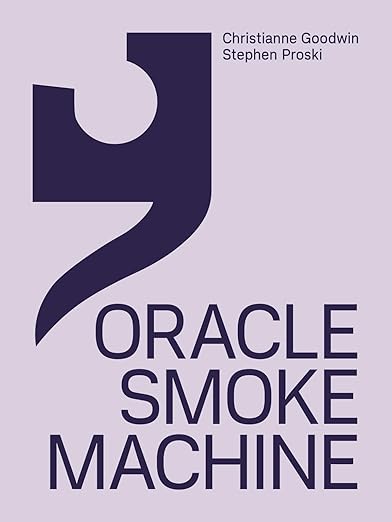
Oracle Smoke Machine, by Christianne Goodwin and Stephen Proski. Staircase Books, 2025. 32 pages. $28.00

by Noah Robie

On the soft lilac cover, the glyph above “Oracle Smoke Machine” arrests the reader’s eye in its
seeming inscrutability: Is it a comma transfigured? a kind of speech bubble arising from the
depths like smoke? Proski’s devil horn and eye inverted, the first work and poem in the book? or
perhaps the cousin to one of the daemonic musical diacritics found on Proski’s sheet music, next
to Goodwin’s “The Clarinetist”? In some sense, the mark on the cover is all these things, and its
openness—the comma, bubble, face, diacritic not closed—articulates the openness with which
Proski and Goodwin approach their artistic process, allowing poem and artwork to play in the
same spaces, and influence each other and what the artist sees.

The notion of seeing—that is, foretelling, seeing beyond—resounds in the collection, beginning
with the title, “Oracle Smoke Machine.” Poet and artist assume prophetic personae of antiquity:
Goodwin as Pythia, the Oracle of Delphi, the high priestess to Apollo, the god of the sun and
poetry—and Proski as Tiresias, the Theban prophet of Apollo, who, also blind, was transformed
from man to woman and back to man by the gods. Goodwin’s lyric prophecy shimmers with an
Apollonian “wash of gold” one finds in work from Klimt’s golden phase.1 Given such a classical
and auroral poetic propensity, one would be remiss not to mention the great poetic prophet of
English letters, John Milton, who wrote his epic, Paradise Lost, after he had become blind in his
adult years. In Milton’s own paean to sight and Holy Light, his divine inspiration for his writing
of Paradise Lost, he exclaims:

So much the rather thou, celestial Light,
Shine inward and the mind through all her powers
Irradiate. There plant eyes. All mist from thence
Purge and disperse, that I may see and tell
Of things invisible to mortal sight.2

Goodwin and Proski both act as our eyes, or plant eyes within us, and, like Milton, tell of things
invisible to mortal sight. Although the poet and artist follow Milton’s inspired practice and
philosophy, their inspiration is slightly different, inflected by Americana, Russian and Hungarian
art at large, and the mechanical-digital age.

In the beginning of the collection, in “Ophanim,” Goodwin alludes to the Biblical priest and
prophet Ezekiel and the many-eyed wheeled creatures that he sees in his visions of God, one of
the first moments in Oracle of mechanism, a potential form of the titular (smoke) machine.
Goodwin writes, “We were alone, but there are eyes everywhere, / Bursting from bark knots and
barley hulls,” selecting the pronoun we to express this plurality of perspective, and writing in the
present tense for her reaffirmation, “There are eyes everywhere.”3 She continues, “We covered
ours, and found // the way home, led by the sun-grow guardians”: Goodwin cleverly breaks the
line and stanza after “found,” emboldening the lyric with the sense that not only did they find
their way home, but that after they covered their eyes, they found, in a more spiritual revelatory
sense.4 In the accompanying lithograph, Proski superimposes a vestigial “POKOL”5—i.e., “Hell” in Hungarian, as the poet later explicates6—in the field of eyes, an artwork we find later on in the
collection, as both an oracular foreshadowing of artwork to come in “Beginner Words” and a
continuation of the devilish theme commenced in “One Night Only!” The multiplicity of eyes,
written and illustrated, becomes a multiplicity of Is, which speaks to Goodwin’s and Proski’s
artistic flexibility, “portaling [us] to paralands”—a Bulgakovian pandemonium or a quotidian
American paradise.7

We witness the absence of a fundamental in “The Clarinetist.” Goodwin describes the very end
of Prokofiev’s ballet Romeo and Juliet, wherein Juliet awakes to find her love dead by her side
and decides to take her life in turn. Goodwin’s naming of the ballet as “Prokofiev’s Romeo”8
portends Juliet’s self-eradication, and torques Romeo’s verse, “But soft, what light through
yonder window breaks? / It is the East, and Juliet is the sun”9: we no longer have Juliet, the sun.
Proski articulates this absence by darkness, a grayscale sheet of music with empty staves.10
Prokofiev’s final movement, “The Death of Juliet,” appropriates many of the ecstatic youthful
themes established earlier in the ballet in “The Y oung Juliet,” and transforms it into a
melancholic dirge. The clarinetist, the agent of the problematic of the poem, misses “The
leitmotif…!,” a musical representation of the solar Juliet, Goodwin perhaps punning on the
German “leit” [to lead] and English “light.”11 It seems that only the “sleeping woman”12 notices,
“the distinct impression of something / missing, forgotten.”13 The poem ends in darkness despite
the audience’s full-throated standing ovation. It recalls Prokofiev’s East, an East with which
Goodwin herself is quite familiar, but not Juliet. But the collection does not end in darkness. On
the contrary, as Goodwin assures us in “The Techno Poem,” “We have our own horizon / of
green laser light.”14

1 Christianne Goodwin, “Sunrise,” in Oracle Smoke Machine (Cambridge, MA: Staircase Books, 2023), line 4, p. 22. All further references, of Goodwin’s poetry and Stephen Proski’s artwork, will be from Oracle Smoke Machine unless indicated otherwise.
2 John Milton, Paradise Lost (New Y ork, NY: Norton, 2021), 3.51–55.
3 “Ophanim,” line 3, p. 4. Emphasis added.
4 Ibid., lines 8–9.
5 “Ophanim” [artwork], p. 3.
6 “Beginner Words” [artwork], p. 11; “Beginner Words,” line 9, p. 12.
7 “Feychild,” line 7, p. 18.
8 “The Clarinetist,” line 2, p. 24.
9 William Shakespeare, Romeo and Juliet (Washington, DC: Folger Shakespeare Library), II.ii.2–3, p. 69.
10 “The Clarinetist” [artwork], p. 23.
11 “The Clarinetist,” line 24, p. 24.
12 Ibid., line 28.
13 Ibid., lines 34–35.
14 “The Techno Poem,” lines 22–23, p. 34.

Noah Robie is a writer who sometimes lives in Massachusetts and other times in Paris.

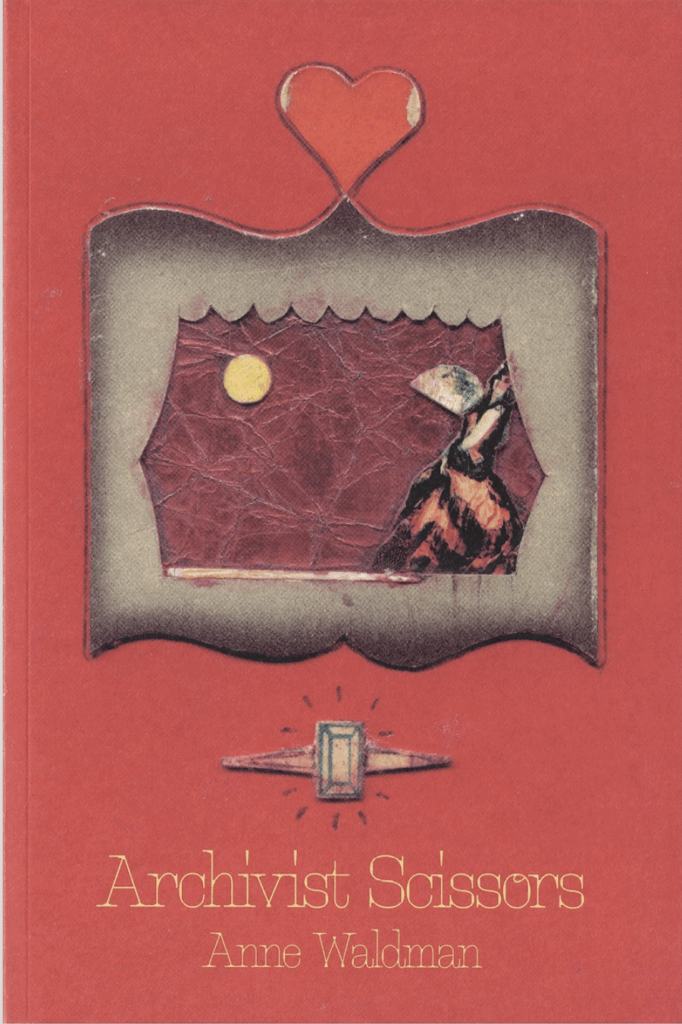
A Review of Anne Waldman’s Archivist Scissors

Archivist Scissors, by Anne Waldman. Staircase Books, 2025. 59 pages. $20.00

by Michael McGillicuddy

The Poetic Demand & The Gift of Poetry: On Anne Waldman’s Archivist Scissors

Archivist Scissors: a retrospective on the one hand, a creating on the other. Cutting up the archive and making out of it something new, which is nonetheless something old, related as it is to the archive. Older than old? Certainly—Waldman’s poetry gives us to the origin of language, wherein the materiality, the sound of the word and the meaning of the word are not yet scissioned. So the poem “Buoyant” says, “I’ll sing to the elements / in my archivist scissors.” The song addressed to the elements and of the elements, unearthed in the workings (unworkings?) of the archivist scissors. Cutting up in order to unify, disarticulating in order to articulate? A Burroughsian, a Kristevan demand. What are we to make of Waldman’s poetic gift, to what end is Waldman giving it to us—how should we be to best receive it?

The self-evident sensuous beauty of Waldman’s poetic word can’t be given by criticism, for, in taking it as my object, I have separated the meaning of the word and the materiality of the word. As soon as I describe her words with different words—different marks, sounds—I’ve subordinated material to meaning. Criticism is something of a virus, then, burrowing itself into the body of work. And suddenly Burroughs is back on the scene, brought to the fore with the evocation of the word virus—of whom Waldman described in Fast Speaking Woman as empowering her “with his uncompromising sense of the wicked power and magic of words.” Says in “Existential,” contra Burroughs,

Language is not virus if we take back
Its power, our mundane but a tool
toward sound, and beauteous telepathy

“toward sound,” and so reuniting the meaning, the use of the word (“a tool”) with its materiality. Nonetheless the if,” the agreement with Burroughs that we are, in our everyday, subject to the “dead labor” of the word virus, doomed to reproducing “meaningful” relations for the virus, of the virus—and so reclaiming relations for ourselves, reclaiming the space of mediation, is the poetic task. Taking back the word’s power, disclosing the promise of “beauteous telepathy,” founding a radical community. Archivist Scissors is a poetic fulfillment of the task, overflowing as it is with homages, dedications, quotations, evocations to the dozens of people coming into presence with, through, as Waldman.

“And all of us ‘in relation’ to all the fabulous others,” Waldman says in the expansive “Fugue State,” a poem in which the power of language is certainly reclaimed, but for whom? Not only for Waldman, as if she, as seer-poet, stood above and beyond us, the reader (listener?)—and we know this because the poem is a fugue state, a poem in which the validity of the responsible subject isn’t merely contested but thrown aside, the poem rapidly moving from association to association, carving out relations otherwise inaccessible to the grammatically coherent “I.” “[C]ome to this Kristeva moment,” “Ponder” says, and Archivist Scissors is a collage of “Kristeva moments,” for the poems are all concerned with unearthing what Kristeva calls “the semiotic,” the generative, disruptive, rhythmic chaos out of which our everyday symbolic codes are always drawn—which is at once the disclosure of other possible manners of being oriented toward the world and toward others. Others “fabulous” not only in our good fortune of being in relation to them, but in their possibility, their as yet unrealized potential, their unreality—elsewhere described by Waldman as “all karmas we are party to.”

Language gives itself to us and, being in this relation, we must in turn give language our responsibility toward it—which is not to be found in a particular discourse touting itself as universal, but in language’s holding open (for us!) the possibility of discourse at all—which is not nothing, not an empty potentiality I attempt to indicate by pointing confusedly to my apparently thinking head, but the materiality of the word, the word meaning its materiality.

Waldman takes up a double negation in “What Is an Individual if not This Genius,” a prose poem negating prose’s tendency toward meaning, prose being the negation of the materiality of the words constituting it. Like Rimbaud, like Burroughs in his Nova Trilogy, in which Rimbaud is folded. Burroughs’ forceful, disarranged, sensuous style characteristic of his cut-ups is echoed in Waldman’s poem, but the poem—contra Burroughs, who wanted at all costs to “rub out the word,” to find a means of communication “healthier” than language—preserves language and, in that preserving, brings language back to its materiality and re-apprehends “its power,” its tendency “toward sound,” its promise of “beauteous telepathy.”

Meredith thinking with the things she loves. Languaging her hold on them. Sing
with them a Turtle’s dream. Dakini language whispered in twilight. Oracular now
time.

Ways of eyes and syllables may blaze together in genetic zone. Ritual space as
emptiness dials down. Vulnerable and climbing. Spiraling and standing still. And
take all with you. A dialogue in the antechamber. Poiesis in the culture wars.
Oneiric dreams of synergy fielding 200 billion galaxies Spaces are already sacred,
and scary, and we’ll stand by our words.

Through the poetic word’s disruption of our everyday symbolic codes, which have always already assigned to “me” an everyday sense of which my being must, and apparently always already does, reflect—the most obvious of which is: I am I, I possess the words I say and I can be held against, exchanged with the words I say—and through deploying implicit quotation and the cut-up method to speak as others (“I is another,” so Rimbaud, “I am a dissipative structure—a flowing apparent wholeness, highly organized but always in process,” so Waldman), Waldman’s work discloses a radically communal, communally radical poetic space. The work calls attention to the fact that the language I speak is never simply my own, that language always implies a relation and so is charged with instability—and is therefore not something “I” “simply” “possess.” So what does Waldman’s poetry give us in its uncovering of a space not yet subjected to the reign of the everyday? The insurrectionary depth of poetic speech.

Arriving at the limit of everyday sense—a sense indicated through the adherence to grammatical standards, the utterance sensible insofar as it maintains itself within these standards and valuable insofar as it is simultaneously a justification of and expression of these standards, part of a system and so exchangeable against any other utterance, term in that system—which is to say, transgressing everyday sense through an operation that makes it inoperative, intimating not nonsense but the possibilities of senses other than, and so beyond, the limits of the everyday. Our everyday? Banal capitalist nightmare of complicity glazed over in the name of a “social contract” from which the sensible possibilities of “human being” are drawn.

I’ll sing to the elements
                                         with my archivist scissors

                              dance on the mall in a cut-out
dakini mask

           what I own
mark the elements

as waves of emotion
          ring breath to
the country that didn’t quite go fascist

“[D]idn’t quite go fascist,” that is, that still has hope, possibility of shaking itself awake, of finding a rhythm unearthed in poetry, enjoyed in poetry. A good fortune which knows itself to be fortunate through its responsibility toward poetry’s space. Demand of responsibility. Part of Waldman’s “Core Text” reads: “We are here to benefit others and disappear.” The opening of the book’s second poem, “Burkina Faso”:

Dearest Mayra—

O big full moon. Yr grandfather—is there a photo of you with him? Friend had
sent shaman words from Burkina “prophecy” of Gaza, the layers, pooling of
blood, many generations, how hard even stand on that surface—how deep the
murders—deliberate violence—& remember Buddhist view of all karmas we are
party to … Manifold grey areas … our USA complicity, our taxes alone turn
weapons. Watched Steve McQueen’s “Occupied City,” terrifying Amsterdam,
looking so sterile. And the addresses & names, a horrible tally. You speak of vow
what’s not been defended … that’s what I am asking of people their vow (their
voice, what standing tall far different from opinion) what needs be stood up for. I
need to communicate with you, poetry thru the day waves & night waves. All the
peoples of truth and suffering.

Why the single reference to Gaza in a part of the work which shows itself outside of poetry, that is, in the form of a letter in which the meaning of language is once again privileged over its materiality—a prose which, though trembling, seeks to understand and to teach? If the first poem of the book serves to orient us, it follows the stakes of the book might be sketched out in the second. Certainly. More profoundly, it is perhaps because to enjoy in sound and meaning implies the accomplishment of a task that could be called poetry, the accomplishment of taking the language I speak and bringing it back toward that space in which it has not been subject to laceration. From this perspective, to speak of Gaza poetically would be to imply the accomplishment of reuniting the material reality of Palestinian forms of life with what might be called the “meaning of Palestine,” a relation in which Zionist oppressors have always already intervened, have appropriated as their own and for their own ends. That poetic enjoyment, then, would be for us (“our USA complicity”), but certainly not for the Palestinians. Gaza, the impossibility of its accomplishment in this poetry: inscribed within this painful separation beyond the language of pain is the task Waldman gives us. “[T]hat’s what I am asking of people their vow…” A demand reaching beyond, nevertheless nourished by, poetry.

Michael McGillicuddy is a writer living in Massachusetts. His work can be found in Arts & Letters, Harvard Review, Soundings East, and elsewhere.

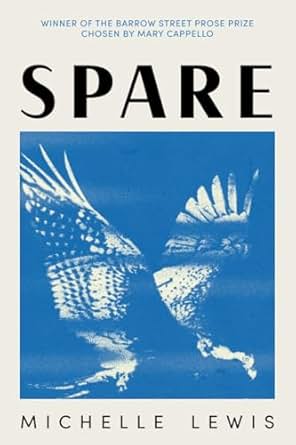
A Review of Michelle Lewis’s Spare

Spare, by Michelle Lewis. Barrow Street Press, 2025. 192 pages. $20.00

by Samantha Colicchio

Zeno’s Paradox describes the way reason diverges from reality. Mathematics teaches us that to walk one mile home, a person must continually “halve the half”: first, they must walk half a mile, and then a quarter of a mile further, and an eighth of a mile further, and then one-sixteenth of a mile further. Continue to add these halved fractions, and the person can never actually reach the mile mark—they are forever approaching it. How, then, can we reconcile them finally arriving home? Is reaching their doorstep an abomination of mathematics, or a miracle?

Michelle Lewis’s breathtaking Spare, a lyric memoir set in Maine, explores fate and fortune through the lens of genetics, class, location, and privilege. Lewis is from one of the poorest towns in Maine, in a region teeming with addiction and “white trash” and a history of eugenics practices, but she lives in an A-frame with her parents and sister and a beautiful nude woman carved into the wood at the top of the stairwell: their own family symbol of fortune. She works with her friend raking blueberries so that she can buy clothes to “pass as fortunate.” Her parents own a restaurant that employs the poorer folks in their town. In a place of violence and drug abuse, she has been “spared”—but just barely. She lives on the cusp: “half of one thing and half of something else.”

What does it mean to reach that mile marker, to transcend the infinite halves and become something else, something impossible? How can we escape what we have inherited? Do we need to? Lewis quotes Robert Browning’s philosophical poem Rabbi Ben Ezra, a meditation on the rabbi’s ideas on fortune. While the book has no overt religious references, the Browning poem points to ideas of divine orchestration, of good coming out of misfortune:

What do we have here, a stillborn. My grandmother tells the story
over and over. It is the same each time: the doctor, who loved
baseball, left to catch the end of the game. When he came back, he
said, c’mon little baby c’mon. Everyone in the waiting room could
hear. By then, the brain was starved, but there was still the body.
He slapped and slapped.

At that point in the story, you might make a plea that air does not
strike the lungs. You might urge the veins not to gulch themselves
with blood. You might say, don’t take that palm of air.

And then she cried.

Lewis meditates upon the idea of “the separation”—the moment when fortunes change. Where does fortune exist? In the genes? In the brain? In the family? In the town? Is fortune a paradox, like Zeno’s? J survived her birth, and that is a miracle. Her brain was impacted by the lack of oxygen, and now J eats ravenously, lunges at others in the library, breaks the good china. Lewis describes her as “like us, with the boundaries lowered.” She tells the reader of J’s love for full-bodied skirts, and describes an image of her spinning in one, the skirt almost parallel to the floor. There is a fierce beauty in J.

Still, there are those who believe they know better than fate. Lewis writes of William Shockley, co-inventor of the transistor and a prominent figure in the eugenics movement, who believed that “cleansing” the population of “the feebleminded” would make for a more intelligent and desirable population. He donated his sperm to the Genius Sperm Bank “to help clean so-called polluted bloodlines.” The sperm bank was a failure and Shockley was eventually ridiculed.

Humming beneath the brutal, often grotesque landscape of the book is a quiet, profound philosophical inquiry. Through sections separated by definitions of spare, Lewis asks: what makes a life worthwhile? What is the truth? What do we inherit? Is fortune random, “the tornado that rips through, decimating one house while the next one is untouched,” or is it in the blood? If a person is “half of one thing and half of something else,” and if each child born means continually “halving the half,” how can we define a life as “fortunate” or “unfortunate”? How can we define an abomination, and how can we recognize a miracle? Lewis quotes Sherwood Anderson in the epigraph, “Hundreds and hundreds were the truths and they were all beautiful.”

Samantha Colicchio is a creative literary fiction and nonfiction writer who focuses on themes of beauty, performance, nature, mental health, and the body. Her work has been published in the Huffington Post, Faultline, The Journal, and HerStry, and is forthcoming in Off Assignment and The Rambling.